If you are a Syrian or you are familiar with Syrian culture, the one thing that you would surely know about the central western Syrian city of Homs (Hims) is that people make jokes about it. The typical joke is about "The Homsi" (el-Homsi; the man from Homs) who says this or that or does this or that, for a ridiculously funny reason. This is the equivalent to the popular Egyptian jokes about the people of Upper Egypt, or the Sa'idis or the other stereotypical jokes in other parts of the world, such as Irish jokes or blonde jokes.
But the reality of the Homsi personality cannot be farther from the stereotype depicetd in the 'Homsi jokes'. If you happen to know people from Homs, they may be some of the most vibrant, intelligent and lively people you know. That is certainly my experience with the people from Homs that I have met in university or later on in my life.
If you look at Syrian television drama works, you find that most personalities other than the famous and popular Damascene personality (e.g. the one you see in the popular Syrian series Bab al-Hara) are really underrepresented. This was also true for example of the Aleppine personality, until several television drama works started to appear and that used the northern Syrian city of Aleppo as the background for its events and that hence accordingly adopted the Aleppine dialect as the one used by its characters. An example of this would be the Syrian series Khan al-Harir [Ar] of 1996, the events of which took place in the famous Aleppine neighberhood that bears the same name, between the years 1955 and 1961. But the representation of the other regional Syrian dialects in Syrian drama series remained incidental and sketchy at best, and was mainly exemplified by the occasional inclusion of characters that conversed using some local Syrian dialect such as the local Latakia (Coastal) dialect or the Southern (Sweida) dialect, for example. When it comes to the Homsi dialect, one personality that stands out in my memory is that of Farhan in the Syrian comedy series "Aileh Khams Njoom" [Ar] (Five-Star Family) of 1993, that was performed by talented Syrian actor Fares al-Hilou [Ar].
Theme song of the Syrian comedy series "Aileh Khams Njoom" (Five-Star Family) (1993)
Now, and for the first time ever, the Homsi dialect is the one used in an entire Syrian drama series titled "Wadi es-Sayeh" (The es-Sayeh Wadi; وادي السايح), the events of which take place in Homs after 1967 (the year Arabs call the year of the Setback or al-Naksah, because of the huge loss they suffered in the Arab-Israeli War of 1967), up to 1970 (the year in which pan-Arab leader Gamal Abdel Nasser died). The social drama series bears the name of a prominent area in the old city of Homs. The name historically refers to a wadi that used to collect water, located to the east of the old city's wall. The wadi used to serve as a protective barrier for the city. The series aims to illustrate the impact the events of 1967 had on Homsi society (which is pretty representative of societies in the Arab World during that time). Several Syrian actors participated in this series including [Ar] Zuhair Abdul Karim [Ar]¸ Abdul Rahman Abul Qasem [Ar], Husam Eid [Eid], Jiana Eid [Ar], Sahar Fawzi [Ar], Lina Karam [Ar] and others. The work was directed by Syrian director Mohamad Badrakhan. It was written by Faculty of Sharia graduate and mosque Imam [Ar] Sheikh Hasan al-Hakim.
According to the Arabic-language portal Discover Syria [Ar], Wadi es-Sayeh is being shown on Syrian TV in the current month of Ramadan.
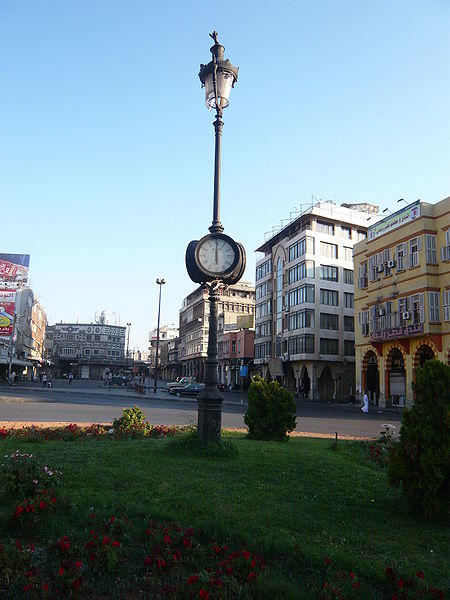 |
| Old Clock in the city of Homs, Syria. Photo Credit: Bo yaser. Shared under the Creative Commons Attribution-Share Alike 2.5 Generic license. |


